
How VPPs can help manage an increasingly electric future
N. Mughees | August 28, 2020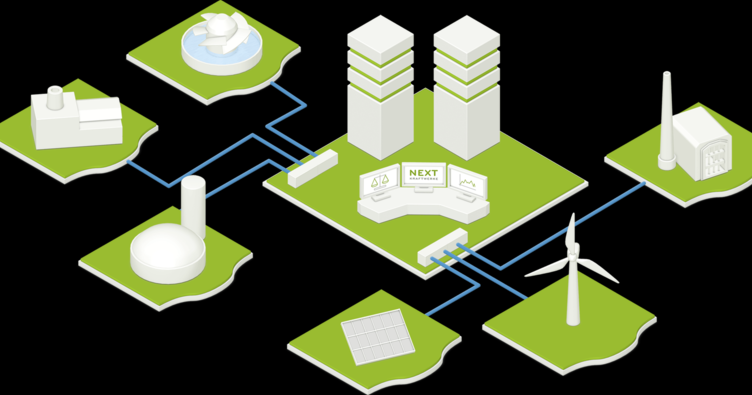 Visualization of a VPP. Source: NextKraftwerke/CC BY-SA 4.0
With the increasing penetration of renewables into the power network, optimal control and operation of distributed generation (DG) is more important than ever. However, if the generating units are not in harmony, integration of DG can lead to increased power losses in the grid, unwanted voltage profiles and inadequate functioning of protective devices or imbalances between consumption and production. To properly manage and control the units and minimize these drawbacks, it is imperative that these units are visible to the system operator of the main network. This is where the concept of virtual power plant (VPP) comes in.
The idea of VPPs has been around for decades, but there is no common definition that the research community unanimously agrees on. The basic concept behind a VPP is that an aggregation of controllable loads, DG units and energy storage systems are linked to a cluster inside a virtual entity. This entity manages the flow of electrical energy within the cluster as well as its exchange with the external power grid. Despite there being no formal definition, there are a few key characteristics that are fundamental to the design of VPPs. A central information center is an essential part of every simulated VPP. This enables the VPP to acquire and efficiently process the information about its internal energy resources in real-time and extract useful data for its overall optimization. Furthermore, VPPs are not bound by geographical constraints and can integrate distributed energy resources (DER) ignoring the power grid topology except the power flow limits. However, the design of VPPs must always align with the ISO safety regulations. Another key characteristic shared by all simulated models of VPPs is the dynamic operation and optimization. DER integration by VPP represents a dynamic profile rather than a static mathematical model, which ensures that the optimization strategy proposed by VPP is not only the best economic operational plan, but it also takes into account the real-time operating status of the power system.
The optimum VPP system seeks to improve its output and minimize the cost of the energy produced. The study of optimization techniques is a hot topic for the ongoing research on the VPPs. Optimization of the VPP focuses on internal energy dispatch and external market involvement. The power system under study, whether it's new or existing, determines the methodology of VPP optimization. In the case of existing and established power systems, options are limited when it comes to choosing the size of DG units and energy storage systems or the location of flexible loads. These things are predetermined. However, in case of a power system that is newly established, VPP has the option of choosing the location and capacity of production units and the location of flexible loads as well. This allows for the implementation of suitable control and optimization strategies.
Moving on to the energy resources integrated by VPP, both renewable and conventional energy resources can be a part of the VPP. Renewable energy resources typically integrated in a VPP are small scale units as VPPs are not suitable for large scale renewable energy stations (large wind farms or hydropower stations) that have output in megawatts. Another interesting component of the VPP can be the plug-in hybrid electric vehicles. There is a risk of unpredictable load fluctuations if the charging and discharging of electric vehicles is not controlled and managed properly. VPP can be designed and configured to reasonably distribute the charging of electric vehicles over time and avoid any significant fluctuations in the network.
VPPs are divided into two main parts: Technical virtual power plant (TVPP) and commercial virtual power plant (CVPP).
CVPP
DERs are considered commercial entities by the CVPP and it sees their price and energy capacity information for optimization and economic utilization. This enables CVPPs to have bilateral contracts with both the customers and the DG units. Normally, small DG units cannot participate individually in the electricity market but CVPP makes sure that these units are visible to the electricity market. In addition to trading in the wholesale market, CVPPs are involved in the production scheduling based on the predicted customer requirements. CVPPs predict the amount of generation and consumption based on electricity load curves and weather forecasts. They are also responsible for management of possible outages.
TVPP
TVPPs ensure proper functioning of the DG units and energy storage systems, handle the energy flow within the VPP cluster and provide supplementary services. TVPPs receive CVPP details on contractual DGs and controllable loads and this information usually includes the commitment and maximum capacity of each DG unit along with the consumption and production forecasts. By utilizing the particulars of the topology of the distribution network along with the details provided by the CVPP, TVPP ensures optimized and secure operation of the power system. TVPPs manage the local system for distribution system operators and also ensure that the distributed energy resources in the distribution network are visible to the transmission system operator. TVPPs also contribute in fault detection and facilitate maintenance.
Conclusion
The concept of VPPs is relatively new but quite appealing, requiring rigorous research to make execution easier. However, the applicability and effectiveness of VPPs is evident from its practical application in certain European countries. The concept of VPPs could undoubtedly play an important role in the future power system and it might prove to be a major breakthrough for optimization and control of the distributed energy resources.



A rolling black-out is a VPP. Already in use today.