Vacuum processing improves perovskite solar cell stability
S. Himmelstein | May 01, 2020Organic-inorganic hybrid perovskite solar cells offer greater solar conversion efficiencies and lower manufacturing costs relative to silicon solar cells. However, these benefits are undermined by stability issues, as exposure to moisture, heat and light takes a toll on device performance. A new material processing protocol engineered by an international research team promises to boost the operational stability of planar hybrid 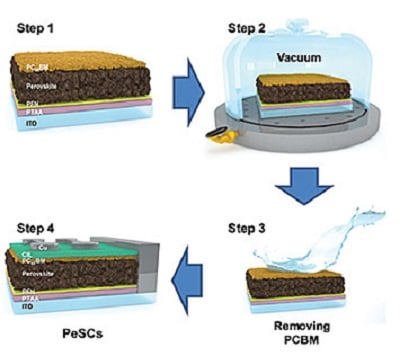 Schematic shows the vacuum and solvent process for removing ionic defects that reduce the performance of hybrid perovskite solar cells. Source: U.S. Brookhaven National Laboratoryperovskite solar cells.
A vacuum curing process is applied prior to electrode placement on the top layer of the solar cell. Loose ions from the perovskite concentrate at the top interlayer; these ions tend to leach out of the material during the lifetime of a solar cell and reduce conductivity and efficiency. The concentrated layer is then eliminated with chemical solvents in a second processing step, leaving a highly crystalline perovskite material behind. Materials characterization assessments revealed a smaller concentration of ions at the surface relative to an unmodified sample surface.
A hybrid cell synthesized with the new process was demonstrated to maintain 90% or more of its initial 18.8% power conversion efficiency for 1,000 hours of standard operational testing conditions. The ionic defect-free device proved stable with no burn-in loss.
Scientists from Gwangju Institute of Science and Technology (South Korea), Hanwha Solution (South Korea), Korea Research Institute of Chemical Technology (South Korea), Imperial College London, Stony Brook University and U.S. Brookhaven National Laboratory participated in this research.