
An open source library for 3D deep learning research
S. Himmelstein | December 03, 2019A new resource is now available for the development of 3D models for deep learning applications in robotics, artificial intelligence and other fields. The open-source software library assembled by Nvidia supports multiple representations of 3D data.
Kaolin is a 3D deep learning library for PyTorch designed to allow researchers to load, preprocess and 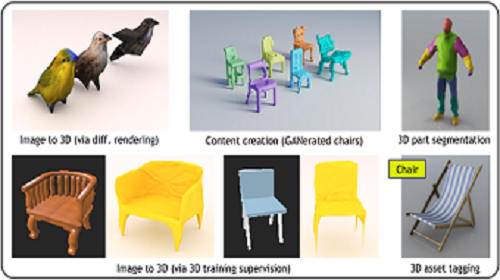 Applications (clockwise from top-left) include 3D object prediction with 2D supervision, 3D content creation with generative adversarial networks, 3D segmentation, automatically tagging 3D assets from TurboSquid, and 3D object prediction with 3D supervision. Source: J. Krishna Murthy et al.manipulate 3D data before it is used to train deep learning algorithms. The system includes graphics modules to edit 3D images, with functions such as rendering, lighting, shading and view warping. Moreover, it supports a wide range of loss functions and evaluation metrics are supported to streamline evaluation of deep learning algorithms under development.
With their 3D dataset ready for deep learning, researchers can choose a neural network model from a curated collection that Kaolin supplies. The interface provides a rich repository of models, both baseline and state of the art, for classification, segmentation, 3D reconstruction, super-resolution and more. Users can select a neural network model from the curated collection, which includes source code and pre-trained models for specific applications.
Future improvements and additions to Kaolin are expected to include newer differentiable rendering tools, large scale semantic and instance segmentation lidar datasets and models for 3D object detection.


I think this is a great technology that will play a role in the future. Thanks to this, we can replace damaged organs or anything like that for the benefit of other people. I think that this development can be cool to use in the future, recently in college we studied this topic and we needed to hand over the project. I wrote mine using https://uk.edubirdie