How does a HEPA filter work?
Engineering360 News Desk | November 13, 2019 Figure 1: A typical HEPA filter.High efficiency particulate air (HEPA) filters and ultra-low particulate air (ULPA) filters are air filters designed to trap a vast majority of very small particulate contaminants from an air stream.
Definitions and efficiency
Air filters must satisfy certain standards of efficiency — most commonly those developed by the U.S. Department of Energy (DOE) — in order to qualify as a HEPA filter. The U.S. standard DOE-STD-3020-2005 requires that a HEPA filter be capable of removing 99.97% of contaminant particles 0.3 μm in diameter. Most standards also specify that HEPA filters must feature minimal pressure drop and maximum airflow when in operation.
A filter's percent efficiency can be calculated using the simple equation below.
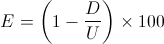
where:
E = percent efficiency
D = downstream concentration (of contaminants)
U = upstream concentration (of contaminants)
Particle size and filtration method
While the U.S. HEPA standard usage of 0.3 micrometer particles to describe efficiency may seem arbitrary, particles of this size are actually the most difficult to filter, rendering them a kind of "worst-case scenario" reference particle. The reasons for this difficulty in filtration are described below.
HEPA filter media is made up of countless randomly arranged fibers that together form a dense mat; when air flows through the filter, the media captures and contains contaminant particles throughout its depth.
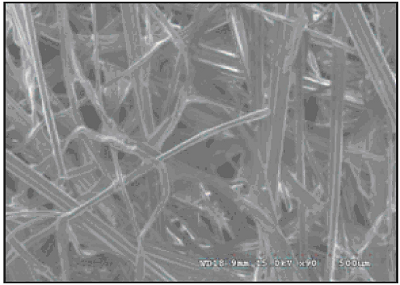 Figure 2: A fibrous filter's media as seen through an electron microscope. Source: ECAT
Filter fibers trap contaminants using three primary methods:
-
Interception takes place when a contaminant particle passes within the distance equal to one particle's radius of a filter fiber, resulting in it touching the fiber and being removed from the airflow. Particles further than one particle radius from a fiber will not be trapped.
-
Inertial impaction occurs when a large particle, unable to adjust to the change in air direction near a filter fiber, becomes trapped on the fiber. The particle's inertia ensures that it continues along its original path instead of circumventing the fiber, resulting in its capture.
-
Diffusion relies on the Brownian motion of gas particles. Small particles (typically 0.1 μm or less) tend to travel on a streamline in an erratic fashion, making random motions as they interact with gas molecules. This erratic motion causes the contaminant particles to become stuck to filter fibers.
Learn more about HEPA and ULPA filters, including relevant standards and applications, on Engineering360's HEPA and ULPA filters information guide.