Why bother with green manufacturing?
Nancy Ordman | July 23, 2019For some background information on green manufacturing, check out Part 1 of Engineering360's series on green manufacturing.
Adjusting any one of the green manufacturing practices could require serious disruptions to inputs and processes fine-tuned to create a profitable operation. Substantial changes, such as switching energy suppliers, reducing reliance on scarce resources, treating effluent and redesigning products for a longer life, need long-term planning and implementation over many years. Company executives must attempt to balance business needs with the motivation to be good corporate citizens.
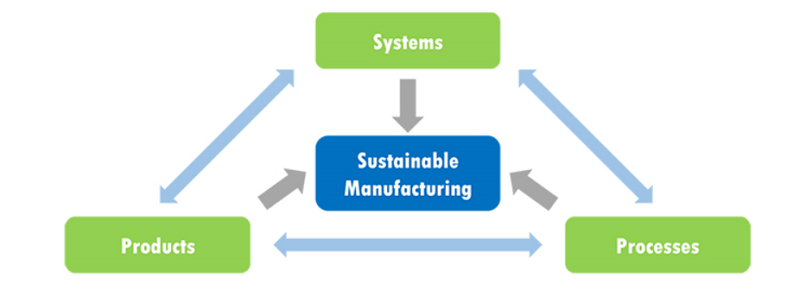 Figure 1: Sustainable manufacturing involves an interplay between products, systems and processes.
Implementing environmentally friendly changes can be good for a company’s bottom line and create a favorable public image – which in turn could spur investment and product sales. How? Here are a few outputs from switching to green manufacturing.
Reduced energy costs: Reducing energy use reduces energy costs. Small changes, like switching to energy-efficient lighting and fine-tuning facility heating and cooling systems, are often possible even when major changes to production systems are not. Substituting renewable energy sources, perhaps adding solar panels on building roofs or unused land around a factory, requires a major capital investment but provides some independence from the energy grid.
Develop new customers: An increasing number of customers, both business-to-business and business-to-consumer, prefer to support green manufacturers. Companies that manufacture products that help companies go green can also expect to gain new business over the next years and decades.
Increase company value: Financial analysts reward companies that prioritize environmentally responsible practices with higher ratings. Researchers at the Harvard and London business schools discovered this unanticipated benefit. Companies that perform poorly on environmental responsibility pay a price, including higher interest rates on debt.
Financial incentives: In the U.S., local and state governments offer different types of incentives, including rebates, tax credits, loans and grant programs to businesses as well as individual consumers. The Dsire website breaks down these incentives by state.
Some of the planet’s best-known companies have implemented some of the green practices described earlier.
· Brooks developed a completely biodegradable running shoe.
· Hewlett-Packard has a goal to produce 100% recyclable products, and the company has opened its own e-waste recycling plants.
· Dell supports an efficient and effective computer recycling program and agrees to accept a computer, printer or monitor made by any company, not just Dell products.
· Honda, Tesla, Toyota and other automobile manufacturers produce hybrid and all-electric vehicles.
· S.C. Johnson reduced use of coal-generated power by switching to natural gas in most facilities. The company also eliminated 1.8 million pounds of volatile organic compounds from its Windex product artifacts and 1.4 million pounds of polyvinyl chloride from Saran wrap.
Companies smaller than these multinational manufacturers can get help identifying ways to implement green manufacturing. NIST’s Manufacturing Extension Partnership (MEP) has centers in all 50 states and Puerto Rico whose mission is to help clients increase sales and decrease expenses.
Although some companies adopt green practices because they are good for the bottom line, not necessarily due to societal pressure, the positive impact on the environment is the same regardless of motivation.