
Chemical toxicity testing without animal models
S. Himmelstein | May 01, 2019Evaluation of chemical toxicity has traditionally relied on the use of laboratory animal models or in vitro bioassays, protocols that may soon be eliminated in favor of a low-cost, high-speed algorithm designed to extract useful bioassay data from a public repository, such as PubChem.
Thousands of compounds used in consumer products have not been comprehensively tested for safety. Animal 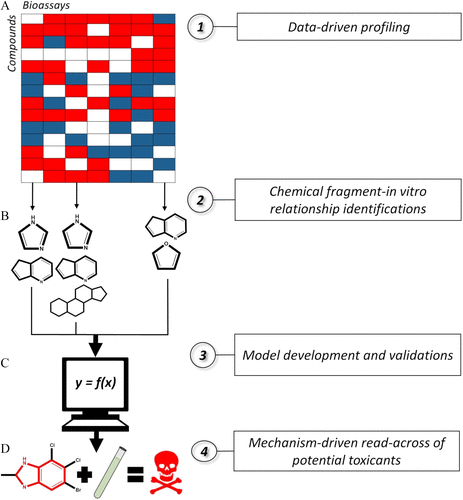 Overview of the data-driven read-across approach. (A) Profiling compounds via PubChem portal, (B) clustering PubChem assays based on chemical fragment in vitro relationships, (C) identifying bioassays capable of predicting acute oral toxicity, and (D) predicting new toxicants by read-across and mechanism illustrations. Source: D Russo et al.testing for this purpose poses ethical concerns and can be too costly and time consuming for practical application. Past efforts to address this problem used computers to compare untested chemicals with structurally similar compounds whose toxicity is already known, but proved unable to assess structurally unique chemicals.
The new computational approach automatically extracts data from PubChem, a National Institutes of Health database of information on millions of chemicals. The algorithm compares chemical fragments from tested compounds with those of untested compounds, and uses multiple mathematical methods to evaluate their similarities and differences in order to predict an untested chemical’s toxicity.
To fine-tune the algorithm, researchers from Rutgers University, Integrated Laboratory Systems (North Carolina) and Johns Hopkins Bloomberg School of Public Health (Maryland) began with 7,385 compounds for which toxicity data is known, and compared it with data on the same chemicals in PubChem. The algorithm was then tested with 600 new compounds and demonstrated a 62% to 100% success rate in predicting the level of oral toxicity for some chemical groups.
The data-driven profiling strategy described in Environmental Health Perspectives can be applied to prioritize potentially hazardous chemicals, reduce the number of animals required for testing and facilitate hazard assessment of high-priority chemicals.

Great news for rabbits, mice, rats and dogs, You are now all unemployed, we are going to maim and murder algorithms in the most humane way possible, Death by Computer.