Using artificial intelligence to keep pace with changing manufacturing requirements
Peter Brown | April 12, 2019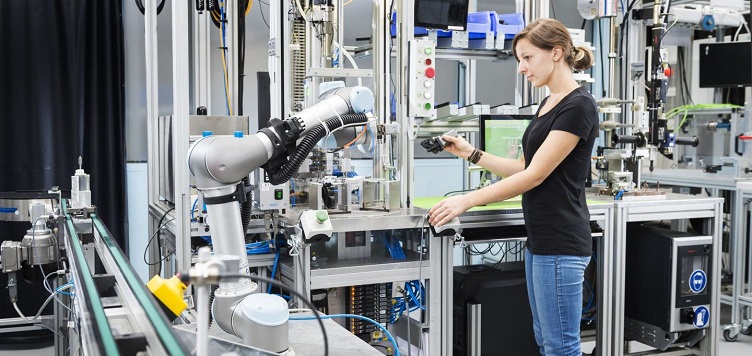 Using AI can help with new ways of manufacturing to meet future demands. Source: Karlsruhe Institute of Technology
Conventional means of manufacturing are reaching the limits of what can be done as product lifestyles become shorter, clients prefer customized solutions and new business models emerge.
In order for line production to keep pace with these changing dynamics, manufacturing must be agile and learn autonomously, responding to requirements in advance to determine the best possible solution.
Karlsruhe Institute of Technology (KIT), an engineering and computer science research group, is working on such an agile production system that adjusts to changing product specifications on its own using artificial intelligence.
The system uses multi-modal sensors simultaneously to measure supplementary environmental data, such as motion and contact as well as implements plant technology, industrial roots and collects production-relevant data. Using this data, driverless transportation systems supply the modular production stations with the necessary goods. Additionally, collaborating mobile and autonomous robots use the data to adapt their action strategies.
"Industrial production has to supply increasingly customized products and be highly efficient at the same time," said Gisela Lanza, researcher at KIT and spokesperson for the project. "This is not sufficient to cope with increasing volatility. In the future, we will not be able to think about everything in advance."
The project, called AgiProbot, is aimed at developing a demonstrator factor for manufacturing of electric motors for the automotive industry. In the project, motors will be disassembled and prepared for reuse. This remanufacturing is an area of high economic possibility and shows the importance of holistic, domain-overlapping and smart production systems.