Follow These Steps to Machine Safety
Dan Hebert, PE | June 16, 2015 Even with a safety system defined, it is important to develop a plan to eliminate, isolate or minimize each risk. If the hazard can be eliminated, it should be eliminated.
Editor’s note. Each year, the U.S. National Safety Council designates June as National Safety Month to focus on reducing leading causes of injury and death at work, on the road and in our homes and communities. Engineering360 supports these and related efforts to make our workplaces safe for all.
The correct design, test and implementation of machine safety systems not only protect workers, but also increase production and profits.
Proper machine design incorporates safety upfront and not as an add-on afterthought. But what happens if the safety system is improperly designed or applied? What if it only looks safe but is not? This condition can be worse than no safety at all, because it may give users a false sense of security.
There are many machines in use today that look safe, but are not because of flaws in their design or implementation. These mistakes can go unnoticed because they have never been tested. The nightmare scenario is when a safety system fails and results in harm. In this case, the system that appears safe is truly more dangerous than the system without any safeguards at all.
Safety Standards
Fortunately, many machine safety standards exist to help with design, installation and testing. In the U.S., worker protection and machine safety is the primary concern of the Occupational Health and Safety Administration (OSHA). The OSHA standard for machine safety is OSHA 29 CFR 1910.212. Other standards-making organizations to reference are:
- American National Standards Institute (ANSI)
- National Fire Prevention Association (NFPA)
- Robotics Industry of America (RIA)
- Underwriters Laboratories, Inc. (UL)
This list is by no means comprehensive. An individual machine may be subject to specific standards and guidelines, depending on its type.
Appearances Can Be Deceiving
Thousands of times each day, risks to an operator’s life and limb occur from machinery that appears to be safe. The faulty safety system is like a ticking time bomb. The operator thinks he or she is safe, and is therefore less cautious than if the risk were apparent.
Take a machine operator who finds a problem in the machine. He sees the bright yellow light curtains surrounding the opening of the equipment, assumes these safety devices will provide protection, and reaches in to fix the malfunction. Except that the safety system does not act as expected, causing harm to the operator and lost time to the company.
Or consider the interlock switch that fails on a guard. Lacking the correct monitoring relays, the operator thinks it is safe. He tries to stop the machine by opening the guard, but creates a hazard for himself instead. The appearance of this guard suggests a properly designed safety system, and this condition becomes more hazardous than no safety at all.
Follow the Steps to Safety
The first step is to identify the hazards (see the accompanying table). Where are the points or areas on the machine that could crush, pinch, pull, cut, twist, hit, shock, burn and so on? Machine designers must document the hazards, and then assess the risks of operators being impacted by these hazards. These include documenting how severe the injury would be if a worker was caught in the hazard, and how often and how likely the hazard may be encountered.
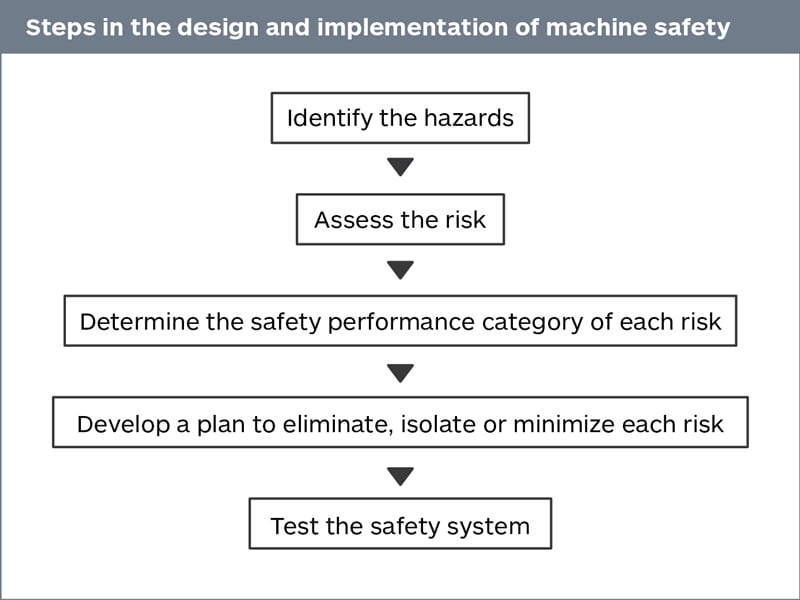 With the hazards identified and the risks assessed, the safety performance category of each risk must be determined and documented. Once the risk is known, standards determine the performance required by the safety system to guard the worker from the hazard. Different hazard types can require different safety systems.
Even with a safety system defined, it is important to develop a plan to eliminate, isolate or minimize each risk. If the hazard can be eliminated, it should be eliminated.
When implemented, the safety system must be fully tested. Each guard switch, light curtain and emergency stop must be tested. Resetting the safety relays should also be checked, especially in systems where a single failure must not only stop the machine, but keep the machine from restarting unless properly reset through monitored contacts.
Protecting Workers Increases Profits
It is important for manufacturing companies to utilize the implemented machine safety. It takes resources, funding, time, knowledge and planning, but the benefits far outweigh the costs. Safer environments and machines improve production by reducing time lost through injury, and by allowing workers to focus on production-related objectives instead of constantly worrying about safety.
Workers’ morale is higher in an environment they know and trust to be safe. If the employer is safety conscious, they will be more involved and work better.
In Charles Duhigg’s book, The Power of Habit, Paul O’Neill, metals manufacturer Alcoa’s CEO, in 1987 began stressing workers’ safety as the top metric by which Alcoa would be judged. Financiers and investors wanted to hear about revenue and profits, not safety, and many of them sold their shares in the company.
But the workers were listening and O’Neill led a change in the company’s culture to focus on safety as the primary metric of success. Lost days to injuries per 100 workers fell from 1.86 in 1987 to 0.2 in 2000. Management and workers collaborated on fixing unsafe and inefficient manufacturing processes. The results were healthier and more motivated employees, and a five-fold increase in Alcoa’s net earnings.
Proper machine safety requires due diligence, referral to the correct standards and understanding the risks. There are many resources available to provide personnel with the training they need to understand how to design and implement proper machine safety systems. The goal must be to continually improve machine safety—and the results will be greater worker safety, improved morale, better product quality, and increased revenue.