
Wind Resource Decline Noted for Northern Hemisphere
S. Himmelstein | December 09, 2018Surface wind speed trends in the Northern Hemisphere and associated impacts on wind power potential were analyzed for the 1979 to 2016 period by Purdue University and Chinese Academy of Sciences researchers. Station observation data show a decline in these wind speeds over North America, Europe and Asia.
A loss of over 30% of wind power potential is determined for about 30% of stations in North America, 50% in Europe and 80% in Asia. These declines in potential are assessed at the typical 80 m typical height of a commercial wind turbine.
The analysis also underscored the poor ability of climate models to simulate temporal trends of surface winds and the need to enhance the reliability of such models by inclusion of better boundary layer and land-atmosphere interaction considerations.
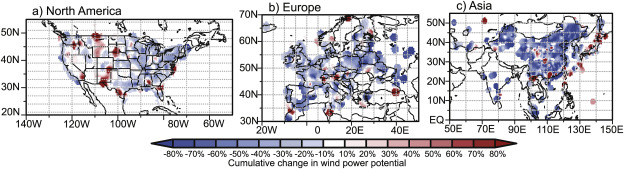 Cumulative changes in wind power potential over a)North America, b)Europe and c)Asia from 1979 to 2016. Source: Purdue University/Chinese Academy of Sciences




..."A loss of over 30% of wind power potential is determined for about 30% of stations in North America, 50% in Europe and 80% in Asia."...
..."The analysis also underscored the poor ability of climate models to simulate temporal trends of surface winds..."...
..."A research team concludes that there could be a 10 percent increase in U.K. onshore wind energy generation..."...
Let's just stop guessing and say you don't know what is going to happen, if anything....at all...
https://insights.glo
In reply to #1
Amen brother.
Is there any correlation between the described observations and the quantity of wind power harvesting installed in that hemisphere over the same period? Now, that query would be well worthy of interest...
We also need to remember that large wind farms are not as efficient, because of self shielding. I've also wondered whether the extraction of large amounts of energy from the wind will itself cause further climate change.
In reply to #4
Make Your Wind Farm More Like a Rain Forest Canopy
Meteorologists documented in 1965 that wind speeds below rain
forest canopies was 1 to 5% of the wind 50 feet above the canopy.
Wind farms raise the local effective canopy height to something
approaching the tops of their swept area depending on the density
of windmills in the farm. Prevailing winds rise above this height
to a layer of less resistance. One could work the 1965 study
backwards to estimate the local effective canopy height from
average wind speed 50 feet above the tops of the swept area. Then
lower your anemometer until you just reach 5% of that speed. This
height is the measured local effective canopy height for that
specific wind direction.
Installing additional windmills should always be done at max local
effective canopy height plus at least 50 feet. Fairly quickly
your windmill towers will need to be very high if you have caused
a self shielding dilemma. At least you now have a discipline for
windmill installation with feedback integrating an ROI evaluation.
You can also contour map geographies according to their effective
canopy heights to visualize how your wind harvesting has impacted
prevailing flows. If you keep the gradients in your effective
canopy height minimized, your impact on the overall environment
should be less than if you did not emulate rain forest canopy.
Uniform, lower, surface wind speeds should also reduce dust bowl
effects. Of course, employing this strategy means that wind farms
will be taller and more geographically distributed so the costs
will be higher. Note that the local effective canopy height is
potentially azimuth sensitive so it should be measured when the
wind is blowing in the prevailing direction. If the prevailing
wind direction is seasonal, measurement may be more challenging
and proportional weighting and/or seasonal mapping may be necessary.
Nearby windmills will increase azimuth sensitivity and demand even
more careful azimuth awareness for appropriate analysis.
______________
thewildotter
In reply to #5
Interesting theorizing. Because windmill "canopies" are much less dense than a rain forest canopy, I think the effect will still be there, but much less percentage-wise.
Of course, employing this strategy means that wind farms will be taller and more geographically distributed so the costs will be higher. More geographically distributed means even more problems with NIMBY. Certainly taller means higher costs; I would expect the increased costs will be exponential not geometrical. Does anyone else have feelings about how the costs will increase?
In reply to #6
A Little Wind Energy is Good, A Lot is Too Expensive
Windmill canopy wind interceptors are far grainier than the leaves of a rain forest. The entire area swept by the blades of a windmill is a large rock in the stream kinda like an extremely large round leaf with a bit of a hole in the center where the blades are not moving quite as fast as they are at the periphery.
The cost tar-baby is there whether folks perceive it or not. It is currently hidden globally in the thread subject, in disruption of existing prevailing wind patterns, and locally in the self shielding phenomenon. I am just suggesting a discipline for adjusting to it. This energy source has diminishing returns and should be used in moderation.
I actually think that ground supported windmills in a long term, high density sense are spitting into the wind since the expenses to get high enough above the canopy rapidly pass a sharp cost knee. In my previous post I was hoping to enable others to come to that conclusion for themselves. At low levels of deployment wind is better since one does not pay proportionally to the swept area until you massively scale up. Long term, dense implementation of renewable non-hydrocarbon energy sources all suffer from "the cost is proportional to the area employed" problem and have a cost knee where it becomes proportional to higher order polynomials of that area. The essential, overwhelmingly dominant, first order knob on the renewable energy balance sheet is to cap total global energy consumption. You cannot cap consumption without limiting total global population since per capita energy consumption cannot be zero. Capping global population, whether anyone likes it or believes it is politically possible, is inevitable. The only choice is whether it is planned, civilized, and gradual or unplanned, profoundly unpleasant, and extinction level catastrophic.
Hydrocarbon energy sources are not immune from these costs per area considerations but do provide a long term buffer for dealing with variations. We need to be encouraging nature to reload that buffer since it can be largely self sustaining if we do not put human activities in its way. Some large expanses of the global oceans could be devoted to hydrocarbon generation for deep time. We could harvest at the same rate as the oceans generate for a sustainable future if we first control that population knob. Building up the hydrocarbon buffer is synonymous with carbon sequestration except it is not some magical technological way of allowing indefinite population growth via taxation of a doomed middle class for the perpetuation of dominance over the Earth's people by some tiny group of elites. This photosynthetic sustainable scheme may involve a larger total ocean algal biomass requirement at stasis to support our current global population than we can achieve. A sweet point should be sought which preserves human biogenetic diversity and a pleasant life style within the real time hydrocarbon generating capacity available on our spaceship earth.
______________
thewildotter
In reply to #7
One method of population control, thus pollution control, would be to limit the number of children to an average of 2 per female. Some could have more, and some less, to get an average of 2. Not all of these would reach child-bearing age, and the population would gradually decline.