Using Standards to Ease Risks Posed by Radioactive Materials
Morand Fachot, Communications Officer, International Electrotechnical Commission | June 02, 2015 Protection from nuclear risks is a global concern. Accidents in nuclear power plants resulting from natural disasters, technical faults or human errors have heightened public concern about the nuclear industry.
Authorities everywhere try to protect people and the environment from careless handling and storage of radioactive waste material. Governments also see possible criminal or terrorist misuse of smuggled nuclear waste or spent fuel representing serious national security risks.
The International Electrotechnical Commission (IEC) contributes to the safety of nuclear installations, safe handling and storage of fissile material and fight against nuclear smuggling through the work of its TC 45 committee and its subcommittees, which prepare international standards relating to electrical and electronic equipment and systems for instrumentation specific to nuclear applications.
Minimizing Risks in Power Plants
The nuclear power industry has faced challenges in recent years following the March 2011 nuclear accident at Fukushima, Japan. Challenges also arise from the wider availability of fuel resources such as natural gas, which has resulted from new drilling techniques.
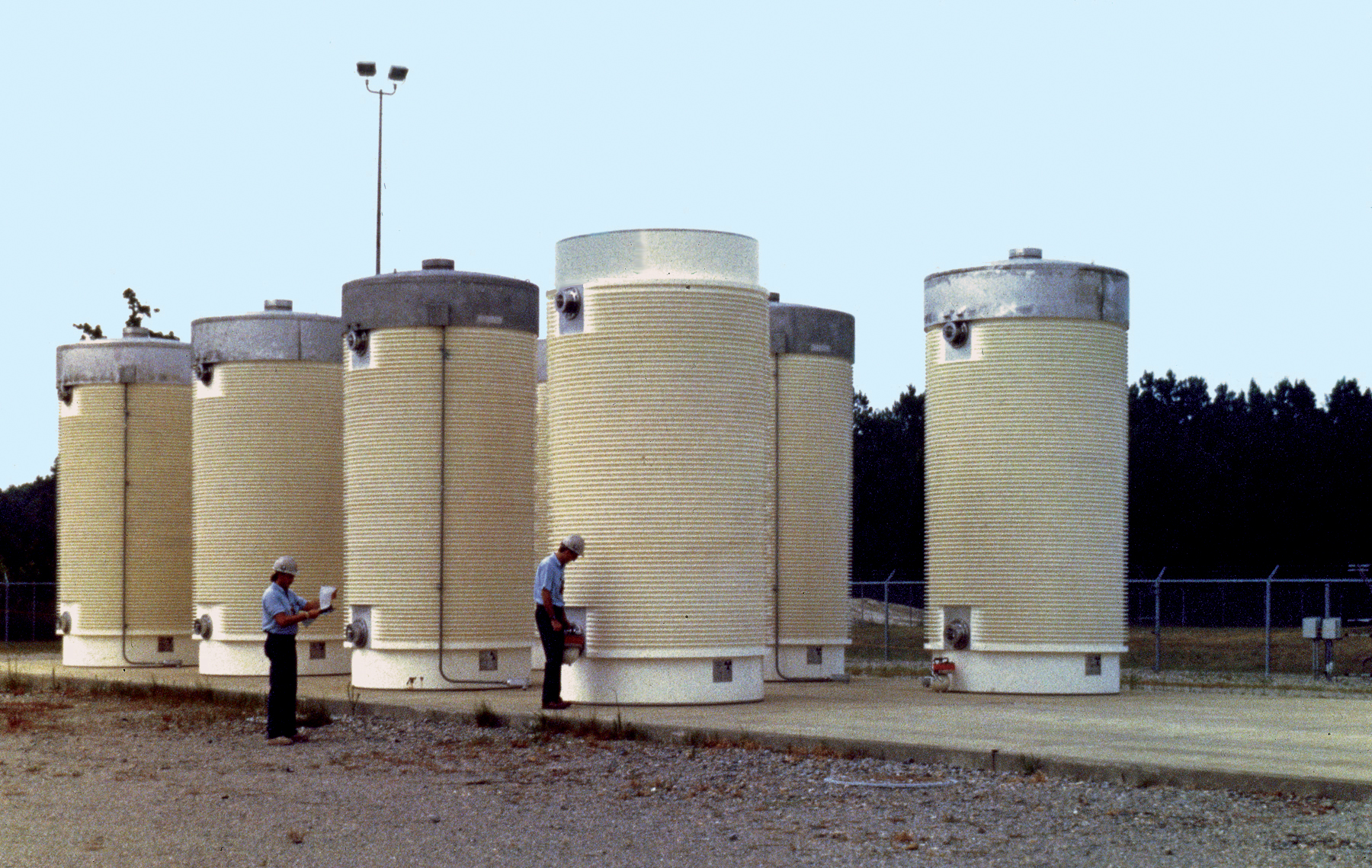 Used nuclear fuel stored in casks at a power plant. Image source: Wikimedia.com These factors have led a number of countries to turn away from or reduce their use of nuclear power in favor of renewable energy sources or less expensive fossil fuels to generate electricity.
New nuclear construction, power plant refurbishment and the dismantling of decommissioned reactors are submitted to tighter reviews and regulations where safety plays a major role and standards for instrumentation are essential.
TC 45 has published 35 International Standards as of June 2015, and its subcommittees develop international standards for the design, construction, performance, testing and calibration of radiation detection instrumentation for all applications.
IEC subcommittee 45A prepares standards applicable to the electronic and electrical functions and associated systems and equipment used in nuclear energy generation facilities (including nuclear power plants, fuel handling and processing plants, interim and final repositories for spent fuel and nuclear waste). The aim is to improve the efficiency and safety of nuclear energy generation.
The core domain of subcommittee 45A is instrumentation and control systems important for safety in nuclear energy generation facilities. As of June 2015, subcommittee 45A has issued 77 publications. Nuclear power plants are among the most rigorously monitored installations and IEC International Standards play a central role for this.
Safeguarding Nuclear Materials
In 1995, the International Atomic Energy Agency (IAEA), the United Nations agency that seeks to promote the peaceful use of nuclear energy, set up a database system—called the Incident and Trafficking Database (ITDB)—to record and analyze incidents of illicit trafficking in nuclear and other radioactive material.
The latest available data (December 2013) shows that the ITDB contained a total of 2,477 confirmed incidents reported by participating states. Of these confirmed incidents, 424 involved unauthorized possession and related criminal activities, 664 involved reported theft or loss and 1,337 involved other unauthorized activities and events. ITDB reported that the majority of unauthorized activities fell into one of three categories: unauthorized disposal (for example, radioactive sources entering the scrap metal industry), unauthorized shipment (for example, scrap metals contaminated with radioactive material shipped across international borders) or the discovery of radioactive material (for example, uncontrolled radioactive sources).
 Billet of highly enriched uranium recovered from scrap processed at the U.S. Y-12 National Security Complex Plant. Radioactive material crossing borders or being moved within countries may not necessarily be the result of criminal activity, but its presence may also result from improper handling of scrapped equipment. As a result, monitoring installations such as scrap metal facilities is important. Other locations where it is important to detect the presence of radioactive material are harbors and border crossings.
Safeguarding Ports
More than 90% of world trade is transported by sea. The majority of goods (with the obvious exception of gas and oil, and dry bulk such as minerals and foodstuff) are shipped in containers. The sheer volume of 20-foot equivalent unit (TEU) containers leaving and entering world harbors is staggering; some 27 harbors shifted more than 5 million TEUs each in 2013, according to the 2014 Lloyd's List of the World's Busiest Container Ports.
Thus, preventing the illegal transfer of radioactive material across borders is best ensured by controlling goods as they enter port loading and unloading areas. This is a difficult task as potentially dangerous quantities of radioactive material are not necessarily voluminous and can be hidden in relatively tiny spaces.
With such volumes of traffic, it is impossible to physically inspect each container. Special instrumentation is needed for this purpose. To be effective, instruments must be highly sensitive and meet strict specifications to ensure they can identify small quantities of harmful products and operate reliably. This type of equipment is widely used for security purposes at nuclear facilities, border control posts and international seaports.
To ensure that measurements made at different locations and with different instruments of the same type are consistent, radiation instrumentation must be designed to uniform specifications based upon performance requirements stated in international standards.
 A U.S. Customs and Border Protection Officer checks a vehicle with a hand-held radiation detection unit. Image source: U.S. CBP Subcommittee 45B (radiation protection instrumentation) prepares international standards for instrumentation used for illicit trafficking detection and identification of radionuclides, as well as radiation-based security screening. As of June 2015, subcommittee 45B has issued 55 publications, six of them for illicit trafficking detection, of which three concern equipment of particular relevance to detection at international seaports. These standards relate to both large systems and portable systems. Subcommittee 45B is also updating existing standards and developing new ones for equipment used in detecting illicit trafficking.
Reliable Radiation Detection
IEC subcommittee 45B prepared, among other standards, IEC 62244:2006, “Radiation protection instrumentation - Installed radiation monitors for the detection of radioactive and special nuclear materials at national borders.” This international standard (which does not apply to hand-held devices) defines “the performance of installed monitors used for the detection of gamma and neutron radiation emitters contained in objects/containers or vehicles, general characteristics, mechanical characteristics, environmental requirements, test procedures and documentation.” These systems are used to monitor vehicles, cargo containers, people, or packages and are typically located at national and international borders.
IEC subcommittee 45B also developed an international standard for portal monitors, IEC 62484:2010, “Radiation protection instrumentation - Spectroscopy-based portal monitors used for the detection and identification of illicit trafficking of radioactive material.”
One factor to consider is that, radioactive materials are transported in shielded containers. Even after shielding, however, some quantity of radiation can be detected, and instruments that meet IEC subcommittee 45B standards are intended to do just that. Note, too, that these standards specify minimum requirements, although equipment often exceeds such minimum requirements.
Protecting Personnel
Most officers who inspect cargo using hand-held detection instruments are not radiation experts. Therefore, their detection instruments must be designed to be user friendly and also must have a high degree of safety. To develop such devices, IEC subcommittee 45B prepared IEC 62327:2006, “Hand-held instruments for the detection and identification of radionuclides and for the indication of ambient dose equivalent rate from photon radiation.” This standard provides guidelines for selecting suitable radionuclide libraries covering radioactive materials that have been most frequently detected at border crossings. Subcommittee 45B published two additional international standards for hand-held instruments to detect radioactive material.
Subcommittee 45B also developed IEC 62401:2007, “Alarming personal radiation devices (PRD) for detection of illicit trafficking of radioactive material.” PRDs are pocket-sized devices carried on the body that alert the user to the presence of a source of radiation that is “distinctly above the measured average local background radiation level.” The standard notes that they are not intended to provide a measurement of dose equivalent rate. IEC subcommittee 45B published another standard for a spectroscopy-based alarming PRD in February 2013.
Work is ongoing to develop new international standards in the field. One such standard concerning backpack radiation detector for detection of illicit trafficking of radioactive material, IEC 62694:2014, was published in March 2014.
These detection devices and others are not just used to detect illegal activities, but in all sectors dealing with radioactive material.
International Recognition
The effectiveness of the radioactive material detection equipment that is designed and built according to IEC subcommittee 45B-developed international standards is confirmed by the following information published in the IAEA ITDB 2014 Fact Sheet: “The reporting of these incidents, especially ‘unauthorised disposal’ and ‘unauthorised movement’ has risen steadily since 2003. There is evidence that this rise is related to the increased number of radiation portal monitoring systems that have been deployed at national borders and scrap metal facilities.”
However, relying on equipment alone is not sufficient to safeguard against the illegal and potentially dangerous entry of radioactive material in any country. The human factor, in the form of properly trained and dedicated staff, remains essential.
Port and border authorities should ensure that both technical means and human resources are maintained at their highest possible levels to prevent illegal entry of nuclear or radioactive material.